Evil Aliens is gross. Not in a vomity sort of way. Rather, lots of fake-ish splattery gore that many "bad" horror movies include in their offering. If you're into the genre, though, the film won't disappoint.
Evil Aliens is a camp-horror-comedy where some Welsh farmers, a UFO geek, and a camera crew face of with a bunch of scary-looking and aggressive aliens. The aliens are set out to conquer and abuse, and the humans are out to defend themselves (sometimes with bats, sometimes with tractors). Honestly, that's really all you need to know to decide whether you want to see this movie or not. Like a Junior High dance, I think you've now divided yourselves against two sides of the room: either hell-bent to see it, or very sure to avoid it.
The best part of Evil Aliens is its references to other horror/thriller and action movies, such as Aliens, Predator, and Evil Dead. Movie junkies will probably get the most fun out of trying to catch all of these reference while watching the gore fly.
Overall rating: 7.0 /10.0
Details:
Runtime: 93m
Country: United Kingdom
Language: English

Saturday, June 24, 2006

Wednesday, June 21, 2006
Review: Blood Rain (SIFF 2006)
Blood Rain is a period detective/crime/mystery movie set on a remote island in early 19th-century Korea. The film begins by showing a fire on one of the ships at the island destined to carry a paper tithe to the King. An investigator is sent to the island to figure out the cause of this fire. While there, the investigator is asked to help solve a series of mysterious deaths.
We quickly learn of a dark past on the island: a man was wrongly executed a long time ago, and now, the locals believe the spirit of this man is killing the informants who wrongly accused him. The investigator witnesses informant after informant dying a gruesome and unexplainable death, and is ever-pressed to figure out who or what is murdering these people.
Blood Rain takes a little while to start up, as you adjust to the period of the film and learn about the setting and the main characters (there are several, with similar-sounding Korean names to my Western ears). But once it does, it keeps your interest like any good murder-mystery does.
Along with the puzzle element of the movie, I enjoyed a glimpse into the societal pressures alternately guiding and forcing the investigator in his quest to solve the mystery, such as one's honor and "place" in society. I can't vouch for how accurate a depiction of 19th-century Korea Blood Rain really is, but the depiction of the characters and their role on this island was nevertheless a nice addition to the mystery element.
Overall rating: 7.5 /10.0
Details:
Runtime: 119m
Country: South Korea
Language: Korean
We quickly learn of a dark past on the island: a man was wrongly executed a long time ago, and now, the locals believe the spirit of this man is killing the informants who wrongly accused him. The investigator witnesses informant after informant dying a gruesome and unexplainable death, and is ever-pressed to figure out who or what is murdering these people.
Blood Rain takes a little while to start up, as you adjust to the period of the film and learn about the setting and the main characters (there are several, with similar-sounding Korean names to my Western ears). But once it does, it keeps your interest like any good murder-mystery does.
Along with the puzzle element of the movie, I enjoyed a glimpse into the societal pressures alternately guiding and forcing the investigator in his quest to solve the mystery, such as one's honor and "place" in society. I can't vouch for how accurate a depiction of 19th-century Korea Blood Rain really is, but the depiction of the characters and their role on this island was nevertheless a nice addition to the mystery element.
Overall rating: 7.5 /10.0
Details:
Runtime: 119m
Country: South Korea
Language: Korean
Tuesday, June 20, 2006
New Restaurant "Fork" Closing Its Doors
We went to Fork recently to celebrate a birthday, and thought it was a great mix of gourmet food and unpretentious atmosphere. Today I read that, because of the chef/owner Scott Simpson's health problems, Fork is closing.
Very sad, but understandable. I hope Scott is able to return to his trade soon, in whatever capacity he can.
Very sad, but understandable. I hope Scott is able to return to his trade soon, in whatever capacity he can.
Sunday, June 18, 2006
Bad Usability: Brookstone Bedroom Clock
When you spend time designing things, it's easy to become a Critique Monster(tm). That is to say, everything non-natural becomes an object of scrutiny, as one critiques why a particular design is (or isn't) so. While I try to keep this to a minimum, sometimes design and usability issues are so blatant that I can't help myself.
Enter the Brookstone 5-in-1 Sensor Clock. It's an attractive little clock/calendar/alarm/thermometer/timer that we've been using the past few days for its alarm feature. The front of the clock is all display and housing. The back of the clock offers the following:
Enter the Brookstone 5-in-1 Sensor Clock. It's an attractive little clock/calendar/alarm/thermometer/timer that we've been using the past few days for its alarm feature. The front of the clock is all display and housing. The back of the clock offers the following:
- Mode Lock (on/off) - slider switch
- Sensor (on/off) - slider switch
- Mode - pushbutton
- Set - pushbutton
- Up arrow - pushbutton
- Down arrow - pushbutton
A "mode" is effectively one of the five features of the clock. The sensor allows you to switch modes by waving your hand over the device, as does the Mode button. The Set button, along with the up and down arrow buttons, allows you to set things like the time.
So, we flipped to the Alarm mode, pressed Set, set the hours, pressed Set, set the minutes, and finally pressed Set again. The alarm was set, and a little alarm clock icon appeared in the upper-left of the display to indicate that the alarm was enabled.
Now, after a few days, we noticed that the alarm was recurring each day at the preset time. Makes sense, especially given that the little alarm clock icon was still there. So, we set out to disable the alarm.
Now, the question: how do you do it?
We tried the following, all to no avail:
- Cycled through "Set" while in the Alarm mode
- Set the hours and the minutes again on the Alarm
- Pressed and held Set
- Pressed and held Set and Mode together
- Pressed the up arrow while in Alarm mode
- Pressed the down arrow while in Alarm mode
- Tried the above with the Mode switch and the Sensor switch set to both positions.
So, what's the answer? A quick flip to the manual for the clock revealed it. You have to press and hold the up arrow while in Alarm mode to enable the alarm, and press and hold the down arrow while in Alarm mode to disable the alarm. Setting the alarm automatically enables the alarm.
What's wrong with this picture? There was absolutely no UI, message, indicator, report, sound, warning, or other method of communicating this information to the user. And we're not talking lack of UI for an edge-case scenario here. Enabling and disabling the alarm is probably one of the most common operations for a little portable clock like this one. To solve the mystery, I had to access Brookstone's web site and browse the manual. If Brookstone didn't have the manual online, I would probably still be stuck.
How did this mistake slip through? In my opinion, I believe the designers here mistakenly assumed that people would read and memorize the manual, to remember this tidbit of information. In reality, most people throw away the manual, throw the clock in the luggage, and go on their way. I bet there's an army of little 5-in-1 Brookstone clocks out there that people are resetting by pulling the batteries out or by inserting a paper clip in the Reset switch, because of this mistake.
This clock served as a reminder to me for one of the most basic design tenets: stay firmly anchored to the users and scenarios you're designing for, and keep prototypes of your design in front of real users' eyes to get honest feedback.
Saturday, June 17, 2006
Fremont Fair 2006
We had a lot of fun today at the Fremont Fair. What appeared to be a cool and cloudy day slowly became a sunny, warm one. The parade was (as usual) festive, musical, loud, and naked (painted, nude bike riders, that is).
Some pictures from the parade:
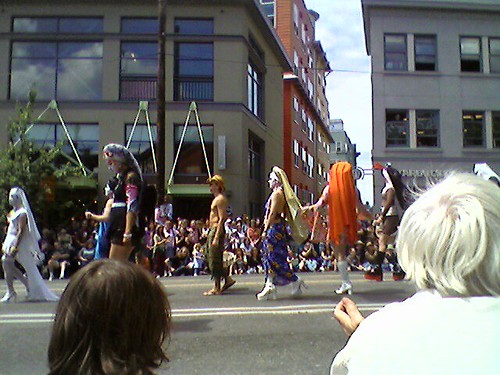
The Sisters of Perpetual Indulgence were out in full force today.
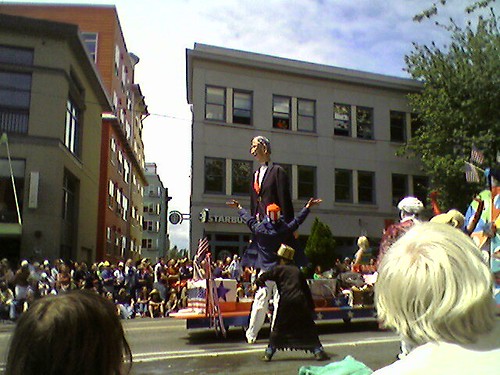
More than one papier-mache version of George W. Bush was on display.
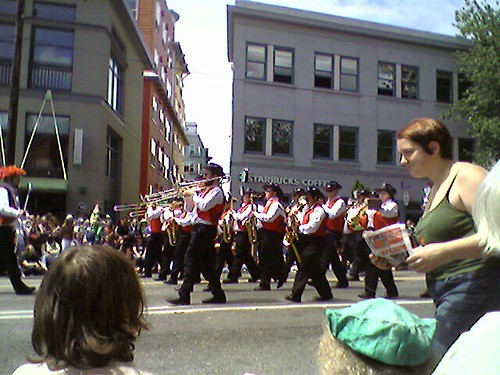
Go, marching band!
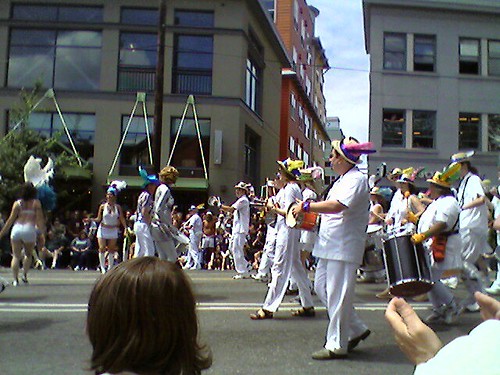
The Brazilian band and dancers were quite good.
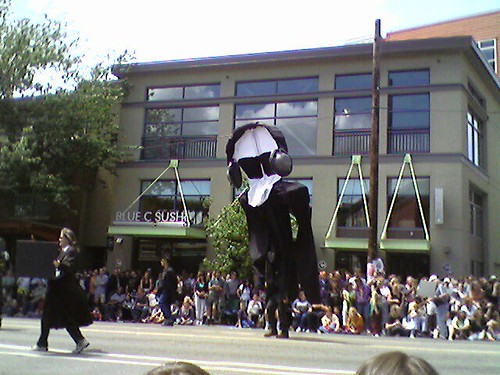
This was supposed to be about spying. Looks more like a large Scream-masked individual to me.
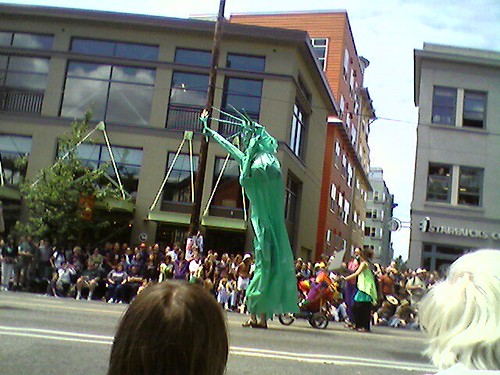
Statue of Liberty.
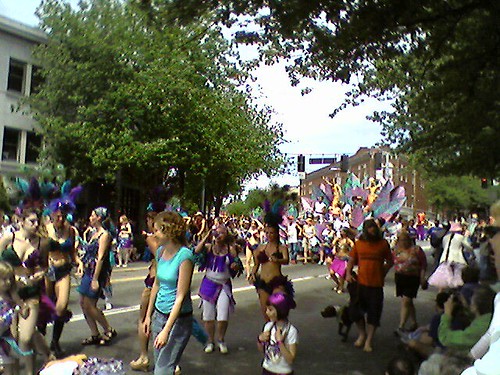
Dancing, feathered people.
Some pictures from the parade:
The Sisters of Perpetual Indulgence were out in full force today.
More than one papier-mache version of George W. Bush was on display.
Go, marching band!
The Brazilian band and dancers were quite good.
This was supposed to be about spying. Looks more like a large Scream-masked individual to me.
Statue of Liberty.
Dancing, feathered people.
Post-Dinner Cupcake Royale
Nothing like a tasty box of cupcakes to bring home after a tasty dinner in Ballard.
As you can tell, they were busy tonight.

But, we scored a box nonetheless.

Yes, new camera phones are fun.
As you can tell, they were busy tonight.
But, we scored a box nonetheless.
Yes, new camera phones are fun.
Sunday, June 11, 2006
Cheap Copper River Salmon At The Seattle Costco
The Seattle Costco has fresh, wild, sockeye Copper River Salmon filets for sale. The price? $9.99 a pound.
To compare, I saw some filets at Whole Foods for sale last week at around $30 a pound. Ack!
To compare, I saw some filets at Whole Foods for sale last week at around $30 a pound. Ack!
Saturday, June 10, 2006
Review: Black Gold (SIFF 2006)
Look down at your cup of coffee. Where was the coffee grown? How many hands touched the beans between field and barista? How much did the farmer get for those beans? What about the other food you eat; how does it measure up?
These are the questions Black Gold posits. While focused on the fair trade movement and its effects in a burgeoning Ethiopean coffee growers co-op, the theme resonates beyond coffee and forces you to question how and where the products we eat and buy come from, and how much the growers versus the middle men are earning for these products.
Black Gold reviews the efforts of Tadesse Meskela, the General Manager of the Oromo Coffee Farmers Co-operative Union. Tadesse's main focus is to remove the middle men between the coffee farmer and coffee roaster, and return more money to the farmer's pocket.
So, what's the problem with conventional coffee? In a sentence, the global price is set in commodities markets in New York and London, and no consideration is given to the local cost of living for a given farmer and his family. Currently, Ethiopian farmers get about $0.24 a kilo. A living wage for them would be about $2.00. That's still a very small price to pay to the grower given the cost of a pound of beans or an espresso drink here in the States, yet prices are kept low and farmers have to make do with a tenth of what they need. Furthermore, World Trade Organization talks in the past few years have failed to negotiate a fair price for coffee and other commodities for the Third World.
The result is that coffee, one of Ethiopia's most abundant natural resources, is sold for very little money. Farmers as a result don't have clean water, enough food, or good schools to send their children. Ironically, the film shows the amount of aid we give to countries like Ethiopia, and contrasts it with the little money we purchase their resources with. It also shows how a very small boost in the GDP of these countries would overshadow the amount of aid that we currently give them.
As a film, Black Gold is very well made. Excellent camerawork, editing, and a comfortable pace, combined with moving images of farmers and their families struggling to survive, make for a great documentary. Add to that the overall message and the information the documentary provides, and Black Gold becomes a movie most any Western consumer should watch.
Overall rating: 9.0 /10.0
Details:
Runtime: 82m
Country: United Kingdom
Language: English, Ethiopian, Italian
These are the questions Black Gold posits. While focused on the fair trade movement and its effects in a burgeoning Ethiopean coffee growers co-op, the theme resonates beyond coffee and forces you to question how and where the products we eat and buy come from, and how much the growers versus the middle men are earning for these products.
Black Gold reviews the efforts of Tadesse Meskela, the General Manager of the Oromo Coffee Farmers Co-operative Union. Tadesse's main focus is to remove the middle men between the coffee farmer and coffee roaster, and return more money to the farmer's pocket.
So, what's the problem with conventional coffee? In a sentence, the global price is set in commodities markets in New York and London, and no consideration is given to the local cost of living for a given farmer and his family. Currently, Ethiopian farmers get about $0.24 a kilo. A living wage for them would be about $2.00. That's still a very small price to pay to the grower given the cost of a pound of beans or an espresso drink here in the States, yet prices are kept low and farmers have to make do with a tenth of what they need. Furthermore, World Trade Organization talks in the past few years have failed to negotiate a fair price for coffee and other commodities for the Third World.
The result is that coffee, one of Ethiopia's most abundant natural resources, is sold for very little money. Farmers as a result don't have clean water, enough food, or good schools to send their children. Ironically, the film shows the amount of aid we give to countries like Ethiopia, and contrasts it with the little money we purchase their resources with. It also shows how a very small boost in the GDP of these countries would overshadow the amount of aid that we currently give them.
As a film, Black Gold is very well made. Excellent camerawork, editing, and a comfortable pace, combined with moving images of farmers and their families struggling to survive, make for a great documentary. Add to that the overall message and the information the documentary provides, and Black Gold becomes a movie most any Western consumer should watch.
Overall rating: 9.0 /10.0
Details:
Runtime: 82m
Country: United Kingdom
Language: English, Ethiopian, Italian
Cat 1, Bear 0
Who says you need a dog to protect you and your property? It turns out a cat can do just fine.
Greece #1
The folks over at Idea Grove decided to put together a whimsical Top 10 Countries list. Looking through it I agree with about 50-60% of it, except for one glaring (and easy to guess) opinion:
Greece should be #1 on the list.
I know, I know, it comes as expected from a Greek, right? But this list puts heavy weight on seminal and past achievements. So many of the countries on the list had big empires at one time or another, and thus had influence on the world (including Greece).
But Greece gave so many creations and inventions and ideas to the world that I do wonder why it's not above, say, the U.S. on the list. Sure, the U.S. is powerful, but it's a young country and hasn't had nearly enough time to provide the world with the same core value that countries like Italy or Egypt or China have had.
Oh well, I guess I'm biased, huh?
Greece should be #1 on the list.
I know, I know, it comes as expected from a Greek, right? But this list puts heavy weight on seminal and past achievements. So many of the countries on the list had big empires at one time or another, and thus had influence on the world (including Greece).
But Greece gave so many creations and inventions and ideas to the world that I do wonder why it's not above, say, the U.S. on the list. Sure, the U.S. is powerful, but it's a young country and hasn't had nearly enough time to provide the world with the same core value that countries like Italy or Egypt or China have had.
Oh well, I guess I'm biased, huh?
Monday, June 05, 2006
Review: Huldufolk 102 (SIFF 2006)
Huldufolk 102 is a captivating documentary about the superstitions that permeate Icelandic culture. The movie involves interviews with several people from various ages and walks of life, and offers slices of opinions, personal histories, and stories of the "hidden people" that abound in Iceland.
Who are the hidden people? Think fairies, elves, trolls, leprechauns, and other little people who are typically unseen but often talked about. They can be good and they can be mischievous. They live in rocks, but you can't see their homes in the rocks unless you're young or you have a gift of "seeing".
Seemingly everyone has an opinion about hidden people. The documentary does a good job drawing from various walks of life in interviewing locals about the Huldufolk. Both Christian and Pagan religious leaders are represented, as are farmers, teachers, scientists, political representatives, and villagers. They each have their own stories to tell and opinions to share.
Do people in modern Iceland believe in these people? Here's the interesting bit: while most people don't say they believe in them outright, at the same time they don't deny their existence. The reason? Many people have stories of unexplained phenomena, which drives the belief forward. For example, there are stories of people being cured of illness after asking for help, road equipment breaking down while trying to move large rocks to make way for asphalt, things disappearing only to reappear days later, and people seen running across a road only later to be seen in dreams.
One of the most gripping facets of the documentary is its depiction of the natural environment of rural Iceland. Rocks abound in valleys, jutting out here and there like miniature mountains. Mist is common in the mornings, adding a translucent light to the air. In one scene, an apparently real-time rolling of fog over a meadow is captured (which was shot in the glow of a midnight sun, we later found out from the directory).
The documentary doesn't set out to answer any of the questions posited regarding the existence of these little people, but does an excellent job immersing the viewer in the folklore and natural beauty of Iceland.
Overall rating: 8.5 /10.0
Details:
Runtime: 80m
Country: Iceland, USA
Language: English, Icelandic
Who are the hidden people? Think fairies, elves, trolls, leprechauns, and other little people who are typically unseen but often talked about. They can be good and they can be mischievous. They live in rocks, but you can't see their homes in the rocks unless you're young or you have a gift of "seeing".
Seemingly everyone has an opinion about hidden people. The documentary does a good job drawing from various walks of life in interviewing locals about the Huldufolk. Both Christian and Pagan religious leaders are represented, as are farmers, teachers, scientists, political representatives, and villagers. They each have their own stories to tell and opinions to share.
Do people in modern Iceland believe in these people? Here's the interesting bit: while most people don't say they believe in them outright, at the same time they don't deny their existence. The reason? Many people have stories of unexplained phenomena, which drives the belief forward. For example, there are stories of people being cured of illness after asking for help, road equipment breaking down while trying to move large rocks to make way for asphalt, things disappearing only to reappear days later, and people seen running across a road only later to be seen in dreams.
One of the most gripping facets of the documentary is its depiction of the natural environment of rural Iceland. Rocks abound in valleys, jutting out here and there like miniature mountains. Mist is common in the mornings, adding a translucent light to the air. In one scene, an apparently real-time rolling of fog over a meadow is captured (which was shot in the glow of a midnight sun, we later found out from the directory).
The documentary doesn't set out to answer any of the questions posited regarding the existence of these little people, but does an excellent job immersing the viewer in the folklore and natural beauty of Iceland.
Overall rating: 8.5 /10.0
Details:
Runtime: 80m
Country: Iceland, USA
Language: English, Icelandic
Sunday, June 04, 2006
Lameness Alert #2: One Thousand Paintings
Soon after I posted about BuyMyDesktop.com, another lame site hits my radar. This one is admittedly SLIGHTLY less lame, but at the same time more infuriating.
The site: One Thousand Paintings. The product: One thousand blank canvases, painted with a blue number (1-1000, ascending). The price: Variable, starting at $40, with current prices in the several hundreds.
So, why is this lame? Sure, numbers are cool. But this artist is putting stenciled numbers on canvas and selling them for several hundreds of dollars.
That said, given copying is a form of flattery, I now announce: One Thousand Sticky Notes. I have 1000 of these babies with a number written on them. By me, personally! Stickiness not guaranteed. Each one's $10 plus shipping (none of this escalating price "because it's an experiment of art and mathematics" crap). Contact me if you want one. Here are some awesome pics of them.


The site: One Thousand Paintings. The product: One thousand blank canvases, painted with a blue number (1-1000, ascending). The price: Variable, starting at $40, with current prices in the several hundreds.
So, why is this lame? Sure, numbers are cool. But this artist is putting stenciled numbers on canvas and selling them for several hundreds of dollars.
- The art is not original (numbers, letters, words, and shapes have appeared alone on canvas before).
- It's impersonal (what part of the artist is in these paintings?).
- It's extremely reproducible (give me a stencil, some blue paint, and some canvas and I'll make you one in 3 minutes).
- It's very overpriced.
- And, to my eyes at least, it's a shallow contrived way of getting lots of cash for not lots of work. Great for the capitalist in you, but where's the art in that?
That said, given copying is a form of flattery, I now announce: One Thousand Sticky Notes. I have 1000 of these babies with a number written on them. By me, personally! Stickiness not guaranteed. Each one's $10 plus shipping (none of this escalating price "because it's an experiment of art and mathematics" crap). Contact me if you want one. Here are some awesome pics of them.
Thursday, June 01, 2006
Jourgensen To Retire 'Ministry', Start Label
Ministry, one of the first and longest-lived industrial bands, will soon produce their final album, followed by frontman Al Jourgensen moving on to managing his new record label.
OK, so he has been at it for 25 years or so. I suppose it's OK to move on to new and different things.
Just so long as you stay in the biz, OK Al?
OK, so he has been at it for 25 years or so. I suppose it's OK to move on to new and different things.
Just so long as you stay in the biz, OK Al?
Tuesday, May 30, 2006
Review: The District! (SIFF 2006)
The District (Nyócker in Hungarian) takes a classic Shakespearean love story, adds some interesting animation, and covers it with a load of obscenities and vulgarity. The result is a visually appealing, if somewhat silly, animated feature that includes lots of tongue-in-cheek commentary on modern politics.
We begin with an overview of life in a district of Budapest, complete with corrupt policemen, rivals between whites and gypsies, and kids who emulate their elders and want to be gangsters. Music ensues, and the kids begin some rapid-fire rapping and describe their situation in musical form.
Soon, a plot emerges: one of the kids wants to get money to win his true love, so he and his science friend build a time machine, and a bunch of the kids go back in time. There, they put a bunch of dead mammoths in a crater, and (flash-forward) you now have oil! Now, you can sell the oil in the world market and make money. Right?
If you have oil under you, people take notice. Enter folks like George W. Bush, Tony Blair, and Vladimir Putin and you have a political smorgasbord in animated form all wheeling and dealing to get a handle on that precious natural resource. If my review sounds scattershot, that's because the movie is as well.
Frankly, I think the most interesting part of this movie was the animation. The bodies of the characters were 3-dimensional and moved in a smooth fashion, while the heads where rapidly-changing still images, which changed to represent the characters speaking, staring, or smirking. The effect was quite captivating, and it waffled between the construction-paper effect of animation like South Park versus the fluid movements of 3D rendered animation.
The movie's fairly explicit, and definitely not designed for children. That said, if you're into animation, this one's unique (and funny) enough to warrant a viewing.
Overall rating: 6.0 /10.0
Details:
Runtime: 87m
Country: Hungary
Language: Hungarian
We begin with an overview of life in a district of Budapest, complete with corrupt policemen, rivals between whites and gypsies, and kids who emulate their elders and want to be gangsters. Music ensues, and the kids begin some rapid-fire rapping and describe their situation in musical form.
Soon, a plot emerges: one of the kids wants to get money to win his true love, so he and his science friend build a time machine, and a bunch of the kids go back in time. There, they put a bunch of dead mammoths in a crater, and (flash-forward) you now have oil! Now, you can sell the oil in the world market and make money. Right?
If you have oil under you, people take notice. Enter folks like George W. Bush, Tony Blair, and Vladimir Putin and you have a political smorgasbord in animated form all wheeling and dealing to get a handle on that precious natural resource. If my review sounds scattershot, that's because the movie is as well.
Frankly, I think the most interesting part of this movie was the animation. The bodies of the characters were 3-dimensional and moved in a smooth fashion, while the heads where rapidly-changing still images, which changed to represent the characters speaking, staring, or smirking. The effect was quite captivating, and it waffled between the construction-paper effect of animation like South Park versus the fluid movements of 3D rendered animation.
The movie's fairly explicit, and definitely not designed for children. That said, if you're into animation, this one's unique (and funny) enough to warrant a viewing.
Overall rating: 6.0 /10.0
Details:
Runtime: 87m
Country: Hungary
Language: Hungarian
Sunday, May 28, 2006
Review: The Death Of Mr. Lazarescu (SIFF 2006)
Lazarescu is a movie that begins and ends in the middle of things, and focuses on the last day of a man's life as both his health and his familiar surroundings slowly decline. We open to see an ill-feeling Dante Lazarescu who, after feeding his cats, decides to call an ambulance to aid with his headache and stomach pain. We learn from the phone conversation that Lazarescu has had an ulcer surgery 14 years ago, that he drinks copiously (much to the dismay of the people on the other end of the line), and that he clearly needs some form of help (judging by the etched lines of pain in Lazarescu's face, and his fits of vomiting).
With the help of his neighbors, a paramedic arrives. At first, she is fairly indifferent, and attributes Lazarescu's problems to his drinking. She starts suspecting a more serious issue is at hand with his health, however, after witnessing his condition, and decides to take him to the hospital.
Thus begins a night of medical red tape and doctor-patient conflicts for Lazarescu and the paramedic. They get shuttled from hospital to hospital, in part because of a serious bus accident eating away at all available hospital resources, and in part because no one wants to deal with an apparent drunkard who just needs to sleep things off. As Lazarescu moves from doctor to doctor, we slowly learn that his condition is quite serious, and we watch him deteriorate to the point of needing emergency surgery. At which, the movie, rather abruptly, ends.
Death is certainly a main theme of the movie. The entire movie takes place at night, with on-again off-again rain smattering the windshield of the ambulance that Lazarescu and the paramedic use to drive from hospital to hospital. We witness the horrible aftermath of the bus accident as patients are shuttled through the hospital hallways. We learn that Lazarescu's wife has died several years earlier of cancer. And, we witness Lazarescu's own decline into apparent death.
However, another theme is the sarcasm of the modern medical profession, and the attitudes and behaviors between doctor and patient, and doctor and non-MD medical staff. We witness the paramedic initially being indifferent to Lazarescu and assuming he's just a drunkard having a bad night. But as she suspects something more serious is at hand, she becomes the voice of Lazarescu to the various doctors she encounters. The doctors are constant skeptics, and they purvey a caste system of "doctor knows right", despite the fact that the paramedic has been with Lazarescu all night and has a history with him (and with prior doctors). The doctors are portrayed very negatively in this movie, with their attention spent mostly on moving people through the medical machinery, making personal phone calls, and fetching food. I could hear the audience utter frustrated sighs as we witnessed doctor after doctor trying to hand off Lazarescu to someone else rather than really focus on him, his condition, and his history like you would expect a doctor to do.
Visually, the style of this movie is similar to a documentary, with most of the camera work appearing to be hand-held. However, the lines are clearly scripted, with actors rarely interrupting each other or being at a loss for words as a "real" documentary would portray. Still, the movie does an effective job of capturing the moment without intruding into it, and without trying to be overly poetic or romantic about the situation (music is almost completely devoid from the movie, save for opening and closing credits and an ambient television here or there). Lazarescu isn't a feel-good movie and doesn't have a clear beginning-middle-end that a traditional story-arced film would, but it's nevertheless worth a viewing, if only to contrast those forms of filmmaking with an interesting alternative.
Overall rating: 6.5 /10.0
Details:
Runtime: 153m
Country: Romania
Language: Romanian
With the help of his neighbors, a paramedic arrives. At first, she is fairly indifferent, and attributes Lazarescu's problems to his drinking. She starts suspecting a more serious issue is at hand with his health, however, after witnessing his condition, and decides to take him to the hospital.
Thus begins a night of medical red tape and doctor-patient conflicts for Lazarescu and the paramedic. They get shuttled from hospital to hospital, in part because of a serious bus accident eating away at all available hospital resources, and in part because no one wants to deal with an apparent drunkard who just needs to sleep things off. As Lazarescu moves from doctor to doctor, we slowly learn that his condition is quite serious, and we watch him deteriorate to the point of needing emergency surgery. At which, the movie, rather abruptly, ends.
Death is certainly a main theme of the movie. The entire movie takes place at night, with on-again off-again rain smattering the windshield of the ambulance that Lazarescu and the paramedic use to drive from hospital to hospital. We witness the horrible aftermath of the bus accident as patients are shuttled through the hospital hallways. We learn that Lazarescu's wife has died several years earlier of cancer. And, we witness Lazarescu's own decline into apparent death.
However, another theme is the sarcasm of the modern medical profession, and the attitudes and behaviors between doctor and patient, and doctor and non-MD medical staff. We witness the paramedic initially being indifferent to Lazarescu and assuming he's just a drunkard having a bad night. But as she suspects something more serious is at hand, she becomes the voice of Lazarescu to the various doctors she encounters. The doctors are constant skeptics, and they purvey a caste system of "doctor knows right", despite the fact that the paramedic has been with Lazarescu all night and has a history with him (and with prior doctors). The doctors are portrayed very negatively in this movie, with their attention spent mostly on moving people through the medical machinery, making personal phone calls, and fetching food. I could hear the audience utter frustrated sighs as we witnessed doctor after doctor trying to hand off Lazarescu to someone else rather than really focus on him, his condition, and his history like you would expect a doctor to do.
Visually, the style of this movie is similar to a documentary, with most of the camera work appearing to be hand-held. However, the lines are clearly scripted, with actors rarely interrupting each other or being at a loss for words as a "real" documentary would portray. Still, the movie does an effective job of capturing the moment without intruding into it, and without trying to be overly poetic or romantic about the situation (music is almost completely devoid from the movie, save for opening and closing credits and an ambient television here or there). Lazarescu isn't a feel-good movie and doesn't have a clear beginning-middle-end that a traditional story-arced film would, but it's nevertheless worth a viewing, if only to contrast those forms of filmmaking with an interesting alternative.
Overall rating: 6.5 /10.0
Details:
Runtime: 153m
Country: Romania
Language: Romanian
Lameness Alert: BuyMyDesktop.Com
Sure, the Million Dollar Home Page was pretty ingenuous. But Buy My Desktop? Sorry, I don't think so.
Pay $25 to get a shortcut on one person's computer desktop. That's only seen by that person. Great, wow, awesome, thanks!
Just so everyone knows: I'm selling a cubic inch of space on my dresser for anyone who wants to place an item there ($10, must be non-volatile). Also, you can put a sticker on my computer mousepad ($20, no larger than 1" square) if you want, or even let me affix a sticky note to my computer monitor with whatever you want written on it ($50, not guaranteed to be sticky forever).
Pay $25 to get a shortcut on one person's computer desktop. That's only seen by that person. Great, wow, awesome, thanks!
Just so everyone knows: I'm selling a cubic inch of space on my dresser for anyone who wants to place an item there ($10, must be non-volatile). Also, you can put a sticker on my computer mousepad ($20, no larger than 1" square) if you want, or even let me affix a sticky note to my computer monitor with whatever you want written on it ($50, not guaranteed to be sticky forever).
Saturday, May 27, 2006
Start Your (SIFF) Engines
It's SIFF time! And, it's rainy, so I don't feel TOO bad spending some time seeing movies during Memorial Day weekend. Let's go!
This blog will take on a bit of a movie-review tone during the next few weeks, as we watch and then talk about some of the movies in the festival. Fear not, after the movie craze is over we'll return to regularly-scheduled programming.
This blog will take on a bit of a movie-review tone during the next few weeks, as we watch and then talk about some of the movies in the festival. Fear not, after the movie craze is over we'll return to regularly-scheduled programming.
Friday, May 26, 2006
Web 27.0 Is Mine!
OK, with all the controversy around O'Reilly's registration of "Web 2.0" as a service mark, I want to make a public statement.
Today, May 26th, 2006, I'm laying claim to the following trademark: "Web 27.0". Right around the time we're ready to release the 27th version of the Web (or at least proclaim the fact that we are), call me up before those conferences get scheduled. You're going to need to pay me some royalties!
No, seriously guys. Web 27.0. It's mine. Talk to my lawyers.
And no, you can have Web 26.0, Web 27.1, even Web 1897.948. 27.0 is where it's at. Seriously.
Today, May 26th, 2006, I'm laying claim to the following trademark: "Web 27.0". Right around the time we're ready to release the 27th version of the Web (or at least proclaim the fact that we are), call me up before those conferences get scheduled. You're going to need to pay me some royalties!
No, seriously guys. Web 27.0. It's mine. Talk to my lawyers.
And no, you can have Web 26.0, Web 27.1, even Web 1897.948. 27.0 is where it's at. Seriously.
Sunday, May 21, 2006
Cal Anderson Park Images
Cal Anderson Park is a great place to visit during these warm months. Formerly an above-ground, fenced-in reservoir, the city transformed the space into a public space complete with fountain, playground, and lots of grass to do with what you will.
The folks over at VRSeattle have posted some QuickTime VR "virtual" shots of the park. They've got plenty of other nice VRs of Washington up there, if you're looking for a virtual tour of the area.

The folks over at VRSeattle have posted some QuickTime VR "virtual" shots of the park. They've got plenty of other nice VRs of Washington up there, if you're looking for a virtual tour of the area.
Saturday, May 20, 2006
Seattle Pug Gala
We love pugs. We don't have one, but many of the folks in our neighborhood do. We see them getting walked and romping in the park all the time. We think they're some of the cutest dogs around.
And, who knew there was a Seattle Pug Gala on? It's a benefit for the Seattle Pug Rescue. Great pics on both sites, if you're a fellow pug aficionado.
And, who knew there was a Seattle Pug Gala on? It's a benefit for the Seattle Pug Rescue. Great pics on both sites, if you're a fellow pug aficionado.
Subscribe to:
Comments (Atom)